
Fundability Secrets Smart Founders Know
An article we liked from Thought Leader Chris Tottman of Notion.vc:
The Startup Fundability Checklist: Are Your Metrics Investor Ready?
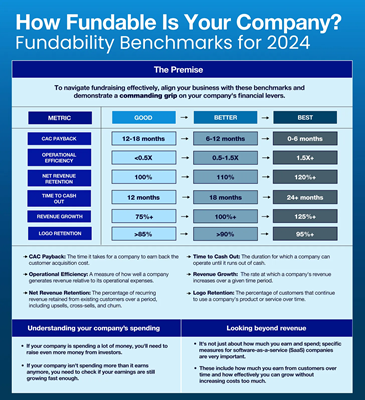
A founder’s guide to the essential benchmarks — CAC payback, retention, efficiency and growth — that determine whether investors see your business as fundable.
Every founder wants to believe their company is fundable. But when investors look under the hood, the numbers tell the real story.
In today’s capital climate, fundability isn’t about storytelling — it’s about metrics.
It’s about proving that your business model can turn ambition into efficiency and growth into sustainability.
These benchmarks — drawn from insights by Bessemer Venture Partners’ State of the Cloud report and refined by leading SaaS investors — have become the yardstick by which fundability is measured. They offer a framework for understanding whether your company is not just growing, but doing so in a way that compels investor confidence.
Let’s break down the numbers that define whether you’re “good,” “better,” or “best” in the eyes of investors — and what they reveal about your business.
1. CAC Payback: How Fast Can You Earn It Back?
If investors could only look at one metric, Customer Acquisition Cost (CAC) Payback might be it.
It tells them how long it takes you to recover the money spent to acquire a new customer. In plain terms — how quickly does your growth start paying for itself?
Best-in-class: Less than 6 months
Better: 6–12 months
Good: 12–18 months
A payback period under six months signals operational excellence and product-market fit. You’re not just acquiring customers — you’re monetising them efficiently.
If your payback period stretches beyond 12 months, it’s a sign to revisit acquisition strategy or pricing. Long CAC payback cycles often point to inefficient marketing spend or over-generous discounting.
2. Operational Efficiency: How Smartly Are You Spending?
Operational efficiency measures how effectively you turn operating expenses into revenue. It’s the ultimate ratio of output to input.
Best: 1.5x or higher
Better: 0.5–1.5x
Good: Under 0.5x
Investors view this as a proxy for scalability. A ratio above 1.5x means you’re generating more than £1.50 for every £1 you spend — a hallmark of efficient, mature SaaS companies.
Fall below 0.5x, and alarm bells ring. It suggests that growth is being driven by unsustainable spending — the startup equivalent of burning the candle at both ends.
3. Net Revenue Retention (NRR): The True Test of Stickiness
Net Revenue Retention is the gold standard for SaaS. It reveals how well you retain and expand your existing customer base, factoring in churn, upsells, and cross-sells.
Best: 120%+
Better: 110%
Good: 100%
An NRR above 120% means…
Read the rest of this article at the-founders-corner.com...
Thanks for this article excerpt and its graphics to Chris Tottman, Founding GP at Notion.vc.
Want to share your advice for startup entrepreneurs? Submit a Guest Post here.