The New Reality of Venture Capital Every Founder Must Face
An article we liked from Thought Leader Donna Harris of Builders + Backers:
The New Physics of Venture Capital

Venture capital is having its biggest year in history.
More than $400 billion has already been invested in U.S. startups through the first half of 2026. AI is driving unprecedented investment. Mega-rounds are back.
That’s the headline. But I don’t think it’s the story.
The more I look at the data, the less convinced I am that we’re witnessing a venture capital boom. Instead, I think we’re watching venture capital itself transform.
This is actually a fascinating moment, and I think people are largely misreading it because they’re interpreting it through the old venture capital framework.
For the past fifty years, venture capital was designed to finance one thing: uncertainty. Find promising founders and ideas. Place lots of early bets. Help companies discover whether they had a business. A few would become extraordinary successes and generate extraordinary returns.
That’s still happening. But it’s no longer the whole market. The underlying economics of venture capital are changing, and the rules of the system are changing with them.
Here are eight forces I think are reshaping the new physics of venture capital.
1. Venture capital is becoming an infrastructure business
Historically, VC was about financing uncertainty. You gave $2M to 100 startups because nobody knew which of the 100 would become a winner.
Today, the largest checks are, instead, financing scale.
OpenAI, Anthropic, xAI, Thinking Machines, Scale AI. They’ve already demonstrated product-market fit. The money is going into GPUs, data centers, distribution, acquisitions, and talent.
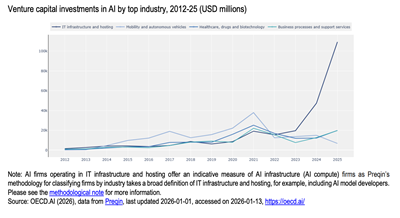
That is much closer to financing railroads, telecom networks, or electric utilities than traditional venture investing.
We still call them venture rounds. But economically, they’re beginning to resemble infrastructure investments more than traditional startup financing. And that’s a fundamentally different use of venture capital.
2. AI is changing the economics of company building in opposite directions
This may be the paradox I find most fascinating.
AI is making many companies dramatically cheaper to build. Small teams can now write software, create marketing content, analyze customer data, provide support, and automate operations in ways that would have required dozens of employees just a few years ago. Company creation is becoming more capital efficient.
At exactly the same time, frontier AI companies are becoming the most capital-intensive startups we’ve ever seen. Training models, acquiring compute, securing energy, and hiring elite technical talent requires staggering amounts of capital. Which is why these firms pull in the majority VC capital.

Both trends are happening simultaneously.
The result is a venture market that’s becoming more polarized. One end requires less capital than ever before. The other requires more than ever before.
3. Increasing returns are changing investor behavior
For decades, venture capital was built around one core assumption: no one could reliably predict which startups would become extraordinary companies, so investors made lots of bets.
VC firms built diversified portfolios, knowing that most companies would fail, some would produce modest returns, and a very small number would generate the vast majority of a fund’s performance. Venture capital became a business of probability rather than certainty.
AI may be changing that. Investors increasingly appear to believe the cycle works like this:
More capital buys more compute.
More compute produces better models.
Better models attract more users.
More users generate more data.
More data improves the models.
The cycle reinforces itself.
Whether or not today’s leaders ultimately maintain those advantages remains to be seen. But investors increasingly appear to believe that…
Read the rest of this article at linkedin.com...
Thanks for this article excerpt and its graphics to Donna Harris, Founder & CEO of Builders + Backers.
Want to share your advice for startup entrepreneurs? Submit a Guest Post here.