How to Win Startup Grants Without Giving Up Equity
An article we liked from Thought Leader Chris Tottman of Notion Capital:
243 Ways to Fund Your Startup Without Giving Up a Share
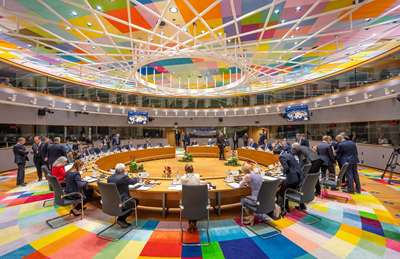
243 programmes. 63 regions. Billions in non-dilutive funding and the eligibility rules that decide whether you see any of it.
Most founders approach grants the same way.
They Google “startup grants 2026.” They find a listicle with twelve entries, eight of which are American. They click three links. Two are dead. One leads to a programme that closed in 2023.
They conclude the whole category is a waste of time and go back to building the deck.
Meanwhile, US federal innovation programmes alone deploy over $4 billion a year into small companies. The European Innovation Council has €1.4 billion committed for 2026. Innovate UK, NRC IRAP, Bpifrance, CDTI, Enterprise Singapore and the Israel Innovation Authority add billions more.
None of it takes equity. None of it takes a board seat. None of it appears on your cap table.
The problem isn’t that the money doesn’t exist. The problem is that almost nobody tells you what actually disqualifies you.
We’ve spent weeks fixing that. The result is a directory of 243 non-dilutive programmes across 63 regions, every one checked against source in August 2026. Award sizes, cadences, realistic odds, direct apply links, and the specific eligibility gate that silently rules most applicants out before anyone reads a word of their submission.
Why Grant Applications Actually Fail
Not because the idea was weak. Because founders write grant applications the way they write pitch decks.
Those are opposite skills.
When you pitch an investor, you are selling a distribution of outcomes. Your job is to make the top of that distribution feel plausible. You lead with the best number. You compress the risk into one slide nobody reads properly. Optimism is the product.
A grant assessor is doing something completely different.
Take Innovate UK as the clearest published example. Your application goes to three to five independent assessors. Each scores individual questions out of 10 against a rubric published before you apply. Scores are moderated across the whole round. Success rates sit in the 10% to 25% band, lower in oversubscribed competitions.
Which means the realistic funding bar is a mid-80s percentage, not the 70 you were expecting.
Assessors are not hunting for reasons to fund you. They are hunting for reasons to deduct.

Three things follow from that, and each one inverts a habit that serves you well in a partner meeting.
1. Unhedged optimism is a deduction, not a strength. Innovation bodies exist to fund the removal of technical uncertainty. If your application reads like there is no meaningful risk left, you have just argued that you don’t need the grant. Name the hard unknown. Then show a credible plan to resolve it.
2. Every sub-clause is a scoring line. Grant questions are three or four questions stapled together with “and.” Founders answer the interesting part, run out of word count, and skip the last clause. That clause carried marks.
3. Scope is checked before merit. Eligibility and scope screening happens before an assessor reads a word of your technical case. A brilliant project in the wrong competition dies without anyone ever reading it.
Stop pitching. Start scoring.
Grants Are Five Different Products Wearing One Word
This is the second reason founders write the category off.
They hear “grant,” picture one thing, and go straight to the hardest version of it.
Layer 1: Credits. Infrastructure and tooling burn. $1k to $350k in kind. Live in days. Near certain at entry tier.
Layer 2: Fellowships and micro-grants. Funds the founder personally, not the company. $500 to $250k. Two to twelve weeks. Assesses you, not your traction.
Layer 3: Tax relief. Pays you back for work you already did. 15p to 27p per £1 spent. One accounting cycle. Near certain if eligible.
Layer 4: Innovation grants. A defined R&D project. $50k to £2m. Four to nine months. Scored against a published rubric.
Layer 5: Blended deep tech. Scale-up and market entry. €2.5m grant plus optional equity. Six to twelve months. Around 3%.
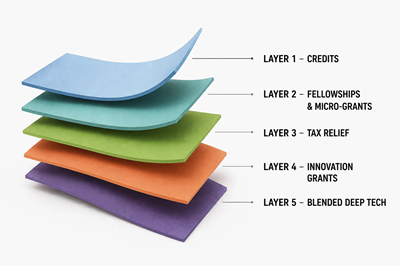
Almost every founder who “looks into grants” goes straight to Layer 4. It is simultaneously the slowest, the most competitive and the most writing-intensive of the five.
Layers 1 and 3 are close to guaranteed money for a company that already qualifies, at a fraction of the effort.
Sequenced properly, each layer buys the runway to work on the next one.
What Each Entry Includes
Every one of the 243 entries gives you nine things:
1. Award size. The real number, not the marketing ceiling. Where a headline figure is only reachable via VC nomination, we say so.
2. Layer. Which of the five above, so you can sort by effort rather than by size.
3. Region. 63 of them, from US state match programmes to Indian state schemes.
4. Stage fit. Pre-incorporation, pre-revenue, post-Phase II, scale-up. Applying at the wrong stage is the most common wasted application.
5. Cadence or next deadline. Monthly, quarterly, annual, rolling, or a specific 2026 date.
6. Effort. Low, medium, high, very high. A Layer 1 credit is an afternoon. An EIC Accelerator bid is a…
Read the rest of this article at the-founders-corner.com...
Thanks for this article excerpt and its graphics to Chris Tottman, Founding GP at Notion Capital.
Want to share your advice for startup entrepreneurs? Submit a Guest Post here.