How to Find the Best VCs for Your Startup
An article we liked from Thought Leader Ilya Strebulaev:
Best-performing investors to target as a founder: not just the famous names
A Stanford GSB professor’s alternative to the Midas List
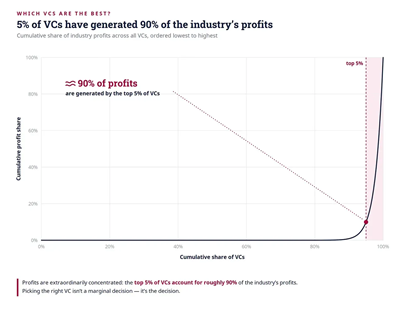
Every founder raising from venture capitalists has heard the same names: Sequoia, Andreessen Horowitz, Benchmark. But one number should shape your fundraising strategy more than any of them. By my estimates, about 5% of venture capitalists have generated roughly 90% of the industry’s profits. If you are choosing whom to take money from, the question that matters most is whether your investor sits in that 5%. Fame is an imperfect proxy for it.
Until now there has been no transparent, fully data-driven way to answer that question. The list the industry leans on, the Forbes Midas List, is largely a black box. When we tried to reverse-engineer it from its own disclosed methodology, even our best-fitting replication left 49 of its own top 100 absent from the actual list. Among investors who appear on both our ranking and Midas, the correlation is only about 0.27.
So together with Blake Jackson I built an alternative: the 2026 Strebulaev-Jackson Venture Ranking, drawn from more than 230,000 investments by nearly 13,000 venture capitalists across more than 5,000 firms over a 30-year window. Every point traces back to a specific investment in a specific company on a specific date. We apply no editorial judgment, make no manual adjustments and do not rely on firms submitting their own numbers.
This article contains the complete top 100, the methodology behind it and, because a ranking alone will not get you a good investor, what to do with it once you have it.
What the score actually measures
Six factors drive it. They are worth reading closely, because between them they reward the behavior a founder should want from an investor.
Valuation, honestly discounted. Two companies can both be described as worth $100 billion when one figure is a public market capitalization and the other a private post-money valuation. These are not the same number, because the preferred stock VCs buy carries downside protections that common stock lacks. My work with Will Gornall put the average overstatement for unicorns near 50%. We discount private valuations uniformly.
Dilution. A 10% stake at the first round is not a 10% stake at exit. Two companies can both sell for $1 billion, but if one raised four rounds along the way, its early investors were diluted round after round. We track each investment’s ownership down through every subsequent round.
Net profit. Turning $10 million into $2 billion is a different achievement from turning $1 billion into the same $2 billion. Subtracting the cost of every investment rewards capital efficiency and penalizes spraying large checks to manufacture a few headline wins. In our data, roughly three-quarters of investments returned negative net profits.
Value add. Investors who lead rounds and take board seats contribute more than passive check-writers, and we award additional points for those roles.
Human-capital decay. A VC’s skill, network and judgment depreciate if not continuously exercised. We discount each investment by time elapsed, using a half-life of three years: a dollar of value created in 2022 is worth about fifty cents in 2025, and a quarter if it was created in 2019. This keeps the ranking current, rewarding investors who are good now rather than those resting on a single brilliant bet from two decades ago.
Credit between firm and individual. Investors move between firms, so when a partner who made their best deals at one firm decamps to another, both firms deserve some credit. We split it, giving a quarter to the firm where the investment was made and three-quarters to the firm where the partner works now. That reflects academic evidence that most return variation traces to individuals rather than institutions.
The 2026 results: top firms
Sequoia tops the ranking with 10,158 points. Andreessen Horowitz is second with 8,292. Accel, DST Global and Tiger Global round out the top five. Two names in that top 20 deserve a second look from any founder building a target list. Parkway Venture Capital, founded in 2019, sits at 19 on the strength of Figure AI. Notable ranks 20th. Neither is a household name, and both outrank firms whose brands are far better known.
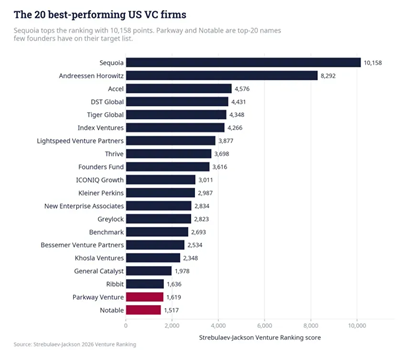
Rank, firm, headquarters, year founded, ranking score and top deal. The top deal is the…
Read the rest of this article at thevccorner.com...
Thanks for this article excerpt to Ilya Strebulaev.
Want to share your advice for startup entrepreneurs? Submit a Guest Post here.