
The Real Economic Power of AI
An article we liked from Thought Leader Noah Smith:
What will more intelligence actually do for us?

A lot, actually. But it won't look quite like what humans do with our intelligence.
“[I]ntelligence, that counterentropic conjoined twin of information, must become the most powerful force in the universe, the energy to which all other physical laws must eventually kneel…Intelligence was destiny, manifest.” — Ian McDonald, “Verthandi’s Ring”
Not a lot of people expected that AI would come for the mathematicians before it came for the truck drivers, but it did. The other day, an AI model disproved the Jacobian Conjecture — an 87-year-old open problem that human mathematicians had struggled to solve. The greatest living human mathematician, Terence Tao, turned to AI to help him understand the solution. Around the same time, AI solved a very important open question in quantum cryptography. Solving Erdos problems has now become almost child’s play for the best AI models. And this is the worst AI will ever be at math. Model capabilities, and the amount of compute available, both continue to increase at rapid rates. (Meanwhile, long-distance trucking employment is slightly higher than it was a decade ago.)
I don’t expect mathematicians to actually lose their jobs en masse, of course. But it’s becoming clearer and clearer that humankind has invented machines that are smarter than we are. Intelligence isn’t defined for machines the same way it is for humans — AI’s capabilities are spiky in different ways than ours — but it’s undeniable that the technology is improving rapidly in every domain of cognitive capability. It’s still possible to find some mental tasks that humans are better than machines at, but those final advantages tend to disappear almost as quickly as we can identify them. “AGI”, or “ASI”, or whatever you want to call it, is certainly here.
And yet…the world remains much the same. In lots of sci-fi books, as soon as artificial superintelligence arrives, it bootstraps itself to even more godlike intelligence in an explosive “singularity” that rapidly transforms the entire physical universe. Lots of people, especially “AI safety” and “effective altruist” types, expected things to play out basically the same way in reality. But looking around, not much has changed since we entered the intelligence explosion. There’s a huge data center boom, and most people use AI on a daily basis, but we still live basically the same lives — driving to work or taking the train, sitting in front of a computer, scrolling on our phones, collecting a paycheck. People are staying in their jobs longer, but employment hasn’t been disrupted in a significant way:
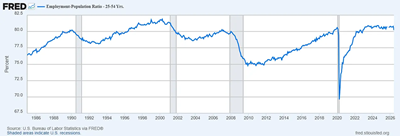
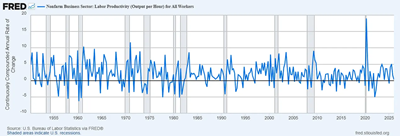
Meanwhile, we’ve had decently robust productivity growth, but nothing really amazing:
A lot of people I know are surprised by this. Ruxandra Teslo writes:
Walking around the world today one might notice that it is weirdly unchanged…To many, this is surprising. Just the other day I was at a conference where someone remarked that if he could have seen today’s AI capabilities a few years ago, he would have been astonished — and would have assumed the world by now would look far more transformed, with much higher GDP growth.
And Clifford Sosin writes:
Superintelligence arrived. You probably didn’t notice, because it turned out to be kind of incremental…Don’t believe me? Run the test. Talk to Fable 5 for an hour, then talk to your ten smartest friends. Which one is smarter? Don’t worry, they won’t be offended…We were told to expect something bigger. Once machines crossed some line, the system’s IQ would climb to heights we couldn’t follow, and we’d be sharing the planet with something that designs warp drives and thinks thoughts as far past us as mine are past my dog…What we got is a tool that writes excellent code, beats people at a startling range of tasks, and will clearly reshape the economy. It’s also, somehow, incremental. No takeoff. No explosion. That’s the strange part.
Teslo blames bottlenecks — governance and other “frictions” — for the slow economic impact. But some others are advancing a more radical hypothesis— that intelligence itself is subject to diminishing returns.
One of these is Francois Chollet, an AI researcher who specializes in measuring AI’s capabilities. In a highly controversial series of tweets back in March, he conjectured that intelligence might be subject to diminishing returns:
One of the biggest misconceptions people have about intelligence is seeing it as some kind of unbounded scalar stat, like height. "Future AI will have 10,000 IQ", that sort of thing. Intelligence is a conversion ratio, with an optimality bound. Increasing intelligence is not so much like "making the tower taller", it's more like "making the ball rounder". At some point it's already pretty damn spherical and any improvement is marginal.
Now of course smart humans aren't quite at the optimal bound yet on an individual level, and machines will have many advantages besides intelligence -- mostly the removal of biological bottlenecks: greater processing speed, unlimited working memory, unlimited memory with perfect recall... but these are mostly things humans can also access through externalized cognitive tools.
In fact, this is a possibility I myself had raised in a post a year earlier:
It seems possible that humans are simply incredibly specialized in a few types of cognitive tasks — extracting patterns from sparse data, synthesizing various patterns into “intuition” and “judgement”, and communicating those patterns in language — and that we’ve basically approached the theoretical maximum in those narrow areas…That would explain why AI has gotten much better at things like math and coding and forecasting over the last year, but why the basic chatbot interface doesn’t seem much more “intelligent”. It would also explain why when you talk to Terence Tao about math, it’s like talking to a superhuman, but when you talk to him about where to get lunch or which movies are the best, he’ll just sound like a fairly smart normal dude. AI will eventually get better than Tao at math…but it may never get much better than the most thoughtful, eloquent humans at deciding where to get lunch or recommending movies. It may simply not be mathematically possible to get much better than we already are at that sort of thing.
Why would intelligence top out like this? Well, if we think of intelligence as the ability to extract information from data, then even an infinitely advanced model endowed with infinite compute will be limited by the fact that there’s a limited amount of information that can be extracted from the data.
For one thing, data itself is in limited supply. You can’t transform the world unless you can (in some generalized sense) understand it, and you can’t understand the world unless you can measure it, and our ability to measure the world is inherently…
Read the rest of this article at noahpinion.blog...
Thanks for this article excerpt and its graphics to Noah Smith.
Want to share your advice for startup entrepreneurs? Submit a Guest Post here.