What You Need to Know: AI’s Next Bottleneck
An article we liked from Thought Leader Neal Bloom of Rising Tide Partners:
AI’s Next Bottleneck Isn’t the Model — It’s the System
From brain-inspired compute to 4W mobile constraints to edge infrastructure—what’s actually limiting AI now.
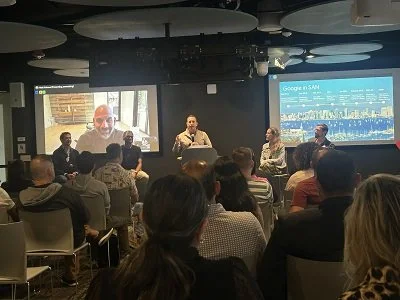
At our recent panel at Google’s San Diego office, the conversation didn’t center on models.
It centered on something more fundamental:
What happens when AI collides with physical constraints?
Energy. Memory. Devices. Trust. Distribution.
The panelists weren’t debating prompts or APIs.
They were describing a system under pressure.
And if you listen closely, you start to hear where things are actually headed.
The Future of Compute May Look Nothing Like Today
Naveen Rao of Unconventional AI pushed the conversation furthest out.
Not just “how do we scale GPUs,” but:
What if the entire way we compute is wrong?
He grounded it in something simple.
Biology.
The human brain runs on ~20 watts
A squirrel’s brain runs on milliwatts
Both outperform our most advanced AI systems in efficiency by orders of magnitude
And yet modern AI infrastructure continues to scale in the opposite direction:
larger models
more compute
more energy
His argument wasn’t that we should copy the brain.
In fact, he explicitly rejected that idea.
“Why does it have to look like the brain? I don’t care if it looks like a brain. I care if it’s efficient.”
Instead, he pointed to something deeper:
There is still massive white space between algorithms and hardware.
Today’s systems:
push noise down to the transistor level
force binary (0/1) abstractions
simulate intelligence through brute-force computation
But biological systems:
tolerate noise
use nonlinear dynamics
compute through interaction, not strict determinism
That opens up an entirely different direction for compute:
using noise instead of eliminating it
leveraging time and dynamics in circuits
co-evolving algorithms and hardware together
And importantly:
“We’ve never been energy-constrained for compute before. Now we are.”
That single constraint may…
Read the rest of this article at risingtidepartners.substack.com...
Thanks for this article excerpt and its graphics to Neal Bloom, Managing Partner of Rising Tide Partners.
Want to share your advice for startup entrepreneurs? Submit a Guest Post here.